Skip to content

IAL Internship Spotlight: Victoria Gevaudan

20231117051700_screen-shot-2023-11-16-at-91643-pm-2

Victoria Gevaudan is an IAL M.Ed. graduate student who is currently interning as a Graduate Assistant for Name, Image, and Likeness (NIL) at the University of Washington. Victoria recently sat down with Jake Silver from the University of Washington Center for Leadership in Athletics to answer a few questions about her experience so far in the IAL program.

This interview has been edited for clarity and conciseness.

Q: How has your perspective on sports and athletics evolved since joining the IAL program?

A: Before joining the IAL program, my perspective on sports and athletics largely came from my experience as a student-athlete. Competing at two different power five institutions, one private and one public, has been extremely eye-opening. This year has allowed me to peek behind the curtain of college athletics, witnessing the extensive work that goes into shaping my student-athlete experience. Also, the NCAA Convention broadened my understanding of the scope of college athletics. Meeting individuals with diverse backgrounds in various sports, conferences, and divisions expanded my view beyond what is portrayed in the media. The convention and the program have enabled me to delve deeper into the complexities of collegiate athletics and sports as a whole, emphasizing the significance of sports in educational systems and society.

Q: Reflecting on your time in the IAL program, how has it influenced your leadership style, especially in the context of working in collegiate athletics?

A: Throughout the IAL program, I have been challenged to reflect on and adapt my leadership style. While I have a lot of experience leading in a sports setting, my approach changes when considering professional roles in athletics or the classroom. Core leadership principles such as discipline, consistency, and communication skills remain, but that works differently between practice and a professional environment. Completing DISC assessments in the class has made me more aware of my leadership style, and caused me to reflect constantly on how my actions align with my values and who I want to be as a person.

Q: What are the main responsibilities of your internship, and what do you enjoy most about it?

A: In my internship, I assist in reviewing and disclosing student-athlete NIL contracts, compiling NIL data into reports, and engaging with UW’s NIL collective. Working with the NIL team and interacting with student-athletes are the highlights of my job. Mentors like Haven Fields, Jamaal Walton, Sam Schwartz, Maya Bulger, and Brett Sible have been invaluable. I appreciate their enthusiasm and a willingness to push the envelope in the NIL space. Hearing creative ways student-athletes are getting involved with the NIL space and maximizing opportunities outside their sport has been inspiring.

Q: Have you had the opportunity to apply knowledge you have gained from the IAL program at your internship?

A: Yes, the IAL program’s emphasis on intentionality has been crucial in my internship, especially in dealing with a student-athlete’s image and brand. We try to encourage athletes to be authentic in who they are working with and what they choose to invest their time in outside of sport. NIL is really a great opportunity for student-athletes to get some professional business experience all while making a little extra money, but at UW we really try to make sure we do that in an authentic and real way. Also, equity is another focus in the IAL program that was threaded throughout my entire IAL experience and extremely relevant to NIL, as many thought that NIL would exacerbate gender inequality in sports. Throughout my internship experience, I have been looking for ways to help bridge the inequality gap, as NIL is truly a great opportunity for all athletes. 

Q: How do you balance the competitive demands of being a Division 1 collegiate athlete, being a graduate student, and being a graduate assistant?

A: It’s all about making the most of your time and keeping your long term goals in mind. I care a lot about school and rowing and obviously want to perform well in each, so that’s in the forefront of my mind whenever I’m making decisions. My coach, Yaz, talks a lot about being present. When I’m at practice, all I’m thinking about is the quality of work I’m putting in and how I’m helping my boat go as fast as possible. When I’m at my internship or doing schoolwork, I try to keep rowing out of my mind and focus on the task at hand. This goes for my free time as well. When I’m hanging out with friends or checking in with my family, I really try to be in those moments and not doing other things. By doing this, I’m getting the most out of each aspect of my life, and it truly helps me enjoy them more.

Q: What has been the most rewarding part of the IAL program so far?

A: The most rewarding aspect of the IAL program has been reflecting on my personal growth and watching my classmates succeed. I am a different person than I was a few months ago coming into the program, and that positive change is completely due to my professors and classmates. Through them I have learned a lot about myself and how I want to contribute to the sports industry. I also love seeing my classmates throughout the day at work and hearing about their internships and celebrating their achievements. We’ve spent a lot of time together, so we are a close knit group, and I love seeing them go after their goals.

Q: Could you share a valuable lesson or piece of advice you’ve received from a mentor within the IAL program, and how it has impacted your approach to your career aspirations in sports?

A: A valuable lesson from my mentor and IAL instructor, Marsa Daniel, has been to approach athletics with a critical lens and challenge norms. With my STEM and athletics background, I am interested in sports performance, and elevating women in sports. Marsa shares both of those passions and has a rowing background, so we have similar approaches to athletics. She has encouraged me to look at systems within athletics with a critical lens and challenge the norms in sports. Additionally, in her sports performance class, I learned the importance of language, and how it can shape athletic experiences. She has challenged me to be clear in my thought processes and dig beyond surface level understanding, which I appreciate. Because of Marsa, I try to be extremely deliberate in both my actions and words. As I navigate my internship and professional career, I look at how the sports industry can be improved and how I can play a role in that.

Q: What advice would you give to incoming students considering the IAL program?

A: The best advice I have received applies to both sports and life: be comfortable being uncomfortable. I’m from Pittsburgh and I had moved to Seattle two days before summer session began, literally knowing no one here. To say I was uncomfortable on my first week of class is an understatement. The IAL program has pushed me outside of my comfort zone in a lot of ways, but through these moments I’ve learned to trust myself and appreciate my growth. A lot of great conversations and opportunities have popped up for me this year by following this advice.

Pictures from a recent NIL event that Victoria assisted with at Husky Stadium.

Our Space in Sport Recap

Thank you to everyone who was involved in the Our Space in Sport Conference! High School girl and non-binary athletes attended sessions highlighting inclusive movement, leadership, mental skills, nutrition, and physiology. This event would not have been possible without the passion and support of our guest speakers and sponsors. 

Event Sponsors: King County Play Equity Coalition, Opal: Food+Body Wisdom, Seattle University, Swire Coca-Cola, USA, WISE Seattle, Women of Washington.

Session Descriptions  

Keynote: Alison Mariella Désir Sport for Change

Discussing the power of sport as a vehicle for connection and social change. Participants should expect to be actively involved, as there will be some movement exercises and Q&A with the crowd.

Nutrition: Monika Van Winkle Connecting to Body Wisdom through Sports Nutrition

Practicing the fundamentals of sports nutrition can help every athlete honor their body’s strength and wisdom. Learn how to recognize diet culture and begin moving away from what our bodies look like toward all the amazing things our bodies allow us to do.

Physiology: Elizabeth Carey Knowing your body

A myth-busting primer on adolescent athlete body development and female athlete physiology, including periods, body changes and more.

Mental Skills: Sarah Smith Mental training skills for optimal performance.

Explore the research-based connection between mental training and sports performance, and then work on a few skills, including self-talk and visualization.  Athletes will come away from the talk with tools to reflect on their thinking before and during competitions.

Leadership: Dionna Leach & Hannah Olson Level Up Your Leadership!

Explore how your leadership style shows up while playing sports and ways that it might shift and change.  You will flex your leadership muscles and come away with your own “Power Statement” that you can use as an athlete!

Closing Panel Kara Ma, Kolo Suliafu, Rosalie Fish

Speaker Bios

Alison Mariella Désir is multi-talented: a founder, a doer, an activist, a connector, a visionary and an unapologetically straightforward communicator with a passion for movement, mental health, and racial equity. Alison got her start in the running and outdoor industry unintentionally, after seeing a Black friend train and complete a marathon. Inspired, Alison went on to run her first marathon and discovered that she had found a powerful tool to manage her depression. She’s been working to share the transformational power of running and movement ever since. Alison is the author of Running While Black and the tv host and producer of the award winning show, Out & Back w/ Alison Mariella Désir (now streaming). In 2023, Alison was named as one of the “45 Most Adventurous Women of the Past 45 Years” by Men’s Journal and one of the “Changemakers of 2023” by Well + Good.  Alison lives outside of Seattle with her partner, Amir Muhammad Figueroa, and their son, Kouri Henri Figueroa.

Monica Van Winkle, MS, RDN is the founder of Nutrition in Action (nutritioninaction.net), a Seattle-based private practice and is currently a performance nutrition consultant for Pacific Northwest Ballet and Seattle Pacific University Athletics. Monica recently co-founded The Embodied Athlete to address issues of under-fueling and overtraining in sport and dance. Previously, she was the Sports Dietitian for the Seattle Mariners (8 seasons) and the University of Washington Huskies (5 seasons), where she was also an affiliate faculty member for the University of Washington Physicians Sports Medicine Fellowship. Monica has a special interest in working with athletes who’ve sustained traumatic brain injuries. If she’s not in her office, look for her rambling somewhere through Pacific Northwest cedar and pine forest or reading up on how to tame her wild rescue pup, Franklin – his namesake is her favorite baseball player, of course.

Elizabeth Carey is an author, writer, and head cross-country coach and assistant track coach at Garfield High School in Seattle. She’s the author of GIRLS RUNNING: All You Need To Strive, Thrive and Run Your Best, with Melody Fairchild. Her work has been published by The New York Times, Outside, Runner’s World, Women’s Running, Trail Runner, SKI Magazine and DyeStat. An endurance coach since 2002, she’s USATF Level 1 and SafeSport certified, and ran Division I cross-country/track for Columbia University

Sarah Hirst Smith is a high school psychology and math teacher, a mental training consultant, a competitive rower, and a mom.  After earning an undergraduate degree in psychology and a teaching certificate, Sarah moved to Seattle to train full-time and made the US National Rowing Team in 2003, 2004, and 2005.  She then began coaching the Pocock junior girls team, who won and got second at US Youth Nationals in 2006 and 2007.  After a break from coaching to raise her twins, Sarah has gotten back into the rowing world through being a Volunteer AssistantCoach with the UW women’s team (2021-2023) and is now working as a mental training consultant with that team, as well as multiple teams at Seattle Academy, where Sarah is a full-time teacher.  In her spare time, Sarah loves backpacking with her dogs, Fozzie and Annie Sue,and her daughters.

Dionna Leach currently serves as the Director of Athletics and After-School programs at St. Thomas School in Medina, Washington. With a background that includes roles as diverse as Assistant Director of Athletics at Lakeside School in Seattle, health and fitness teacher, and student service coordinator, Dionna continues to commit to providing holistic education. Originally from Mill Creek, Dionna holds a bachelor’s degree in family psychology and earned her Master of Education in athletic administration from the University of Washington. She is dedicated to creating inclusive learning environments where every student feels valued and strongly believes in the power of education beyond traditional classrooms.Outside of work, she enjoys traveling with her family, attending sporting events, charcuterie board workshops, and exploring new coffee shops.

Hannah Olson, PhD holds a dual role within the University of Washington’s College of Education as Director of the Center for Leadership in Athletics (CLA) and Assistant Teaching Professor.  At the CLA, her primary area of expertise is within coaching education, developing research-based curriculum and courses for coaches and administrators. Hannah is the CLA’s team leader, lead facilitator, and primary project manager.  On the academic side of the house, she helps drive the Intercollegiate Athletic Leadership (IAL) M.Ed. program, teaching multiple courses, and is responsible for student advising, curriculum development, and internship management.  Additional teaching duties include undergraduate coursework focused on youth development through sport.  Prior to joining UW, Hannah worked in collegiate, interscholastic, and professional sports and has over 20 years of coaching experience.  She earned her M.Ed. (IAL) and Ph.D. (Educational Leadership and Policy Study) at the University of Washington and her B.A. (Psychology) from the University of Virginia.  She has two kiddos (6 & 8) who are the absolute best!

This conference would not have been possible without the generous support of the King County Play Equity Coalition. Learn more about their work here! 

Northwest Association of Sport in Higher Education Forum!

It is with great excitement that we announce the CALL FOR ABSTRACTS for the inaugural 2024 Northwest Association of Sport in Higher Education (NASHE) Forum! It will be held on Friday, April 5th at Husky Stadium in Seattle, WA and is a free event!

The NASHE Forum will consist of a Research/Scholarship Symposium as we invite submissions from individuals engaged in research, teaching, and programming encompassing sport management/administration, sport coaching, recreation, sport studies and other related areas.

We will also be hosting Industry Roundtables in which students (undergraduate and graduate are invited) will work together and network with sport industry professionals on problems of practice.

Learn more!

2023 Year in Review

The CLA staff reflects on how they are developing leaders to maximize the positive and educational impact of athletics. 🏆

IAL Internship Spotlight: Teagan Eldridge

Teagan Eldridge is an IAL M.Ed. graduate student who is currently interning with Glacier Middle School as a P.E. and Health Teacher, as well as a softball and soccer coach. Teagan recently sat down with Jake Silver from the University of Washington Center for Leadership in Athletics to answer a few questions about his experience so far in the IAL program.

This interview has been edited for clarity and conciseness.

Q: What led you to apply to the IAL program? 

A: I did my undergrad at Western Washington University, where I was a student-athlete and studied in Physical Education and Health. I knew I wanted to continue to be in sports after graduating. In 2019, when I was a sophomore at Western, I had a conversation with an IAL alum who strongly recommended the program. This really interested me because I wanted to pursue a career in the sports industry. Since I had that conversation in 2019, my mind has been set on applying to the IAL program. 

Q; What has been the most rewarding part of the IAL program so far?

A: The most rewarding aspect of the IAL program so far has been my internship experience coaching middle school athletes. Over two seasons, coaching girls’ softball and boys’ soccer, I’ve seen the athletes make huge strides and improvements, which has been so rewarding. One moment that stands out was when a player from my boys’ soccer team told me in the middle of a recent game, “I really like how positive of a coach you are.” That was so rewarding and encouraging to hear. I have focused on applying the learnings from IAL into my middle school coaching to create a more positive play environment.

Q: Can you share a memorable experience from the IAL program so far? 

A: The fall extended weekend in October was really nice because I had not seen much of the cohort since the summer, when we were together in class almost every day. Being back with the cohort was especially fun because that week was in the lead-up to the UW vs. Oregon football game and College Gameday coming to campus. The experience of being on campus, surrounded by friends was a refreshing break from the routine of my internship. Our cohort has a really close dynamic. I would consider everyone in the cohort a friend and someone I could call outside of class. We spent a lot of time together outside of summer in the summer and at the fall extended weekend. It’s been really interesting to hear all the different backgrounds of everyone in the cohort. For example, I was a Division 2 student-athlete who played soccer, and someone like Victoria was a Division 1 student-athlete who was a rower. Everyone’s unique undergrad experience and athletic background has helped me learn more about different sides of athletics.

Q: How has the IAL program experience contributed to your professional development?

A: The IAL program has been great for my professional development. I’ve applied learnings from the coaching and pipeline classes into my coaching role at Glacier. Also, the networking opportunities that have come from being in the program have been so helpful because I have been able to have conversations with people in so many different sides of the athletics industry. 

Q: What advice would you give to incoming students considering the IAL program? 

A: For anyone considering the IAL program, I would say the IAL program can open up so many opportunities in collegiate or professional sports. The faculty range from senior-level staff at division one and three schools, beat writers for the Seahawks, law professors, and so many other people who work on different sides of the sports industry. I honestly was not too excited for the law class, but that class was actually one of my favorites because we learned so much about the law and policies of athletics. I have built so many connections through the program. Also, the structure of the program is great because you are surrounded by 40 other graduate students who you quickly become friends with in and outside class.

Q: What are the main responsibilities of your internship and what do you enjoy most about it?

A: I am a P.E. and Health Teacher at Glacier Middle School, teaching classes and coaching softball and soccer. I really enjoy coaching because it is natural for me, coming from an athletics playing background. It is really fun to still be around soccer and help 12 and 13-year-olds learn new parts of the game and keep them playing the sport I love for a long time. 

Q: Have you had the opportunity to apply knowledge you have gained from the IAL program at your internship? 

A: In IAL we have stressed the importance of a coach needing to create a psychologically safe environment. I try to make it very clear to my team that they can make mistakes, and I will not get mad at them. I tell them it’s about how we react to mistakes. If a player loses possession of the ball, a positive response is trying really hard to get the ball back, not sulking or getting yelled at by their teammates or coaches. So many coaches I have competed against over the years make their players feel scared to mess up. In the coaching class, we have learned the importance of a psychologically safe environment. By telling my players they can have a positive reaction after making a mistake, it shows them that as an athlete, it is okay to make a mistake. At the beginning of the season, players on my team would get mad at their teammates for making mistakes. I have coached them to not break their teammates down but instead to build them up through encouragement.

Q: In what ways do you see your IAL experience shaping your future career path? 

A: In the IAL program, we have learned how to make the most of these internship opportunities. I have gained experience in speaking to the parents of youth athletes about problems or issues. I am gaining a lot of experience working through those situations with parents in a professional manner. Discussing sensitive subjects like these with parents is a skill I did not have before the IAL program, but now I feel well-equipped in these situations. Also, faculty like Hannah Olson have been so generous with their time and helpful for my career development. Another faculty member that stands out is Ed Scott, the Deputy Athletics Director at the University of Virginia. I had a couple of individual conversations with him over the summer, which were really impactful. Hearing about what he deals with in his day-to-day job and how he manages the complex situations that pop up in Power 5 Athletics was so fascinating. His professionalism and presence stood out to me, and I recognized I should model his work ethic throughout my own career.

IAL Internship Spotlight: Jessica Eligio

Jessica Eligio is an IAL M.Ed. graduate student interning with the University of Washington Athletics Department as a Diversity, Equity, and Inclusion Graduate Assistant. Jessica sat down with Jake Silver, from the University of Washington Center for Leadership in Athletics, to answer a few questions about his experience so far in the IAL program.

This interview has been edited for clarity and conciseness.

Q: What led you to apply to the IAL program?

A: I initially thought I would start working full-time right after undergrad, but my perspective shifted when a retired Athletic Director from Western Washington University encouraged me to apply to the IAL program. Upon learning about the benefits, hands-on experience, and connections built in the IAL program, I was drawn to the program. The UW IAL program was the only sports master program in the Pacific Northwest I found that I could complete in one year. Also, the opportunity to be the first person in my family to earn a master’s degree, especially in a field as exciting as sports, was a really important factor I took pride in.

Q: What are the main responsibilities of your internship with UW Athletics?

A: As the DEI graduate assistant for the DEI arm of UW Athletics, I oversee the digital side of the DEI team, creating the UW Athletics DEI newsletter for our staff and student-athletes. Additionally, I create content for heritage months, student-athlete affinity groups, and the 3L series. I manage the setup for our events, ensuring they run smoothly, and offer general support to the full-time staff of the DEI team. I am also involved in kicking off the Asian Pacific Islander Collective (APIC) affinity group, collaborating with UW Athletics staff to lay the foundation for this new affinity group.

Q: What is a day in your life like while balancing your internship responsibilities and course load in the IAL graduate program?

A: Balancing my internship responsibilities and the IAL graduate program, especially with an expanded team and increased workload, is sometimes challenging but I have found it to be rewarding. While it can be challenging to make time for schoolwork on some days after my GA position at UW Athletics and part-time job at University Village, doing the IAL coursework centers me. It helps me reflect on my learning and growth in my day-to-day work and experiences in my GA position in the athletic department.

Jessica setting up before the DEI department’s 3L Series: Land Acknowledgment. In observance of Native American Heritage Month, the DEI team walked through the institution’s land acknowledgment curriculum with the UW Athletics Staff. This curriculum provided educational resources about the native land in which we reside.

Q: In what ways has your internship experience complemented or expanded upon what you’ve learned so far in the IAL program?

A: My position has deepened my understanding of inclusivity and diversity, connecting these concepts to the student-athlete experience and their post-collegiate athletics life. Through my position, I have hands-on insights into the administrative side of a Power-5 athletic department, complementing what I learned from the IAL program. Seeing firsthand how a Power-5 athletic department operates and functions has been eye-opening.

Q: How has your internship experience contributed to your professional development and career goals?

A: My internship has enhanced my professional development through a focus on intentionality. I’ve learned the importance of contributing intentionally to building relationships with student-athletes, staff, and our community partners. Having the resources and connections of a D1 institution like UW has shown me the great impact our team can have. Being in the DEI space has made me reflect on my identity and the impact I can have on student-athletes. It has made me more aware of my privilege of growing up in Hawaii, a melting pot, around a diverse mix of cultures and perspectives, which is not as common in the states.

Q: Are there any specific individuals or mentors with whom you’ve connected that have been particularly influential?

A: Yes, Sheridan Blanford, an alum of the IAL program and the Associate Athletic Director for Diversity, Equity, and Inclusion, has been influential. Sheridan’s openness goes beyond work, creating connections on a personal level. Phillip Carpio, Assistant Director of Diversity, Equity, and Inclusion, shares a wavelength with me in terms of how we like to work. He has brought many new ideas to our team, having most recently worked at the University of Nebraska. The Tyee Club, another part of UW Athletics I like to connect with, is where I often catch up with IAL alumni and current IAL students in their office, and they are always great to work with.

Sheridan Blanford, ’16, speaking to the UW Athletics Staff at the DEI department’s 3L Series: Land Acknowledgment.

Q: What has been your biggest highlight so far in the IAL program?

A: The highlight has been creating relationships with so many different people, including faculty members, alumni, UW Athletics staff, and fellow classmates. The program’s diverse cohort, with varying ages and backgrounds, has contributed to a deep learning environment. Whenever I have talked to IAL alumni, they have emphasized the importance of building these connections, emphasizing the lasting impact these relationships can have throughout my professional career.

IAL Internship Spotlight: Tony Wilson

Tony Wilson is an IAL M.Ed. graduate student interning with the University of Washington Athletics Department as a Stadium Operations and Event Management Graduate Assistant. Tony sat down with Jake Silver, from the University of Washington Center for Leadership in Athletics, to answer a few questions about his experience so far in the IAL program.

This interview has been edited for clarity and conciseness.

Q: What led you to apply to the IAL program?

A: Originally, I wanted to become a college football coach or an NFL coach. I viewed the IAL program as an avenue to expand my teaching career and explore coaching opportunities. After conversations with the IAL faculty and a few alumni, I realized that interning in sports administration could enhance my career and still keep the door open down the road for coaching. They emphasized the importance of making sure that my values align with those I work with, and I have found that they really do, especially on the team I am currently a part of at UW Athletics.

Q: What are the main overall responsibilities of your internship with UW Athletics?

A: As a Stadium Operations and Event Management Graduate Assistant, I oversee day-to-day operations at Husky Stadium. This involves a variety of tasks, from security and building access to logistical work. Collaborating with each team’s directors of operations is crucial to make sure all fall and winter sports operate smoothly. I also serve as the point of contact for external organizations renting facility spaces, like I was for the Head of the Lake Regatta.

Q: What was your role at the Head of the Lake Regatta?

A: At the Head of the Lake Regatta, I was the UW Athletics Point of Contact. I oversaw all aspects of the event that took place at UW. The race spanned a three-mile course, starting in Lake Union, navigating through the Montlake Cut into Lake Washington, and finishing near the Conibear Shellhouse. My responsibilities included multiple meetings with the Washington Rowing Association, managing contracts and invoicing, coordinating parking and facility needs, ensuring building security, and working with the Director of Operations for UW Rowing and the Head Coach of UW Rowing. The most crucial components of my role were managing client expectations, preparing for the event from a facilities standpoint, and being the point of contact during potential emergencies.

Q: In what ways has your internship experience expanded upon what you’ve learned so far in the IAL program?

A: My internship has complemented the IAL program by providing inside access to college athletics and giving me opportunities to make numerous connections. Conversations with people like Dan Erickson, the Associate Athletic Director for Events & Facilities and an IAL alum who also came from a teaching background, showed me the real-world application of how I can bring the values I had as a teacher to a career in athletics.

Q: How do you balance your internship responsibilities and course load in the IAL graduate program?

A: Balancing my internship responsibilities with the demands of the IAL graduate program, first involves a daily commute of 2-3 hours, depending on traffic. During breaks in my internship, I find quiet spaces to work on IAL coursework. The IAL faculty’s understanding of the demands of intercollegiate athletics internships allows for flexibility with deadlines during busy weeks, making it manageable to handle both my coursework and my internship responsibilities.

Q: What has been your biggest highlight so far in the IAL program?

A: The biggest highlight for me has been the IAL network. The network helped me land my internship and has been instrumental in my professional growth. The alumni and faculty helped me identify key values that are important to me, be realistic about my goals, and establish relationships with experts willing to provide me with advice for my career. They continue to be a sounding board for questions I have about the next steps in my career.

Check out more photos of Tony and the 2023 Head of the Lake Regatta.

New Study in Collaboration with the WIAA

In collaboration with the Washington Interscholastic Athletic Association (WIAA), we are set to launch a study on education-based coaches and student-athletes across Washington.This nation-leading study will measure the impact of online training in youth development fundamentals on school-based coaches and their athletes. The study is funded by a grant from the National Federation of State High School Associations (NFHS) Foundation.

Coaches will receive foundational training in physical and emotional safety, fostering positive experiences, and effective modeling.The research will assess its impact through pre- and post- season feedback from student-athletes and coaches. Data collection will begin Summer 2024 with findings disseminated Fall 2025. The ultimate goal is to enhance the athlete experience in education-based sports while leveraging findings to create an evidence-based national model for coaching education, replicable for state associations and governing bodies.This study will further our efforts to educate coaches in the foundations of Social Emotional Learning. 

Learn more about our coaching education initiatives and coaching resources here.

IAL Extended Weekend Recap

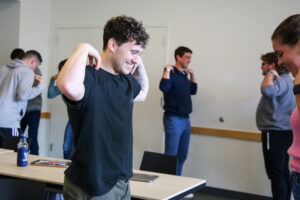
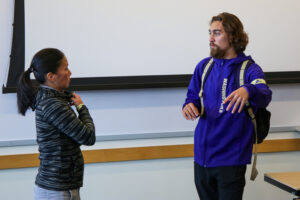
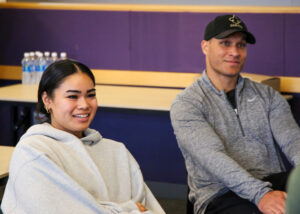
The current cohort of the Intercollegiate Athletic Leadership (IAL) graduate program convened for an immersive three-day extended weekend on campus. On day one, students on the coaching track participated in a physical training lab, while those on the administration track spent the day in their Marketing and External Operations course. For the final two days, the entire cohort participated in classes facilitated by Dr. Hannah Olson on the youth sports pipeline and professional development.

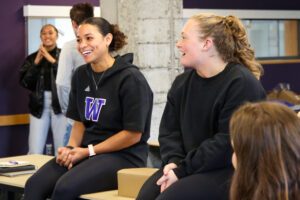
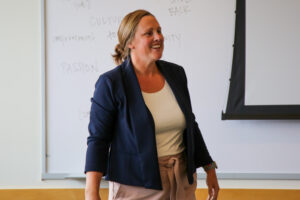
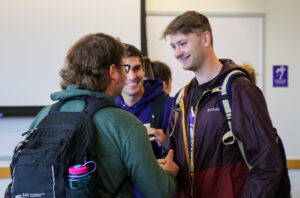
During extended weekend, IAL graduate students shared the highlights of their internship experiences across the country.

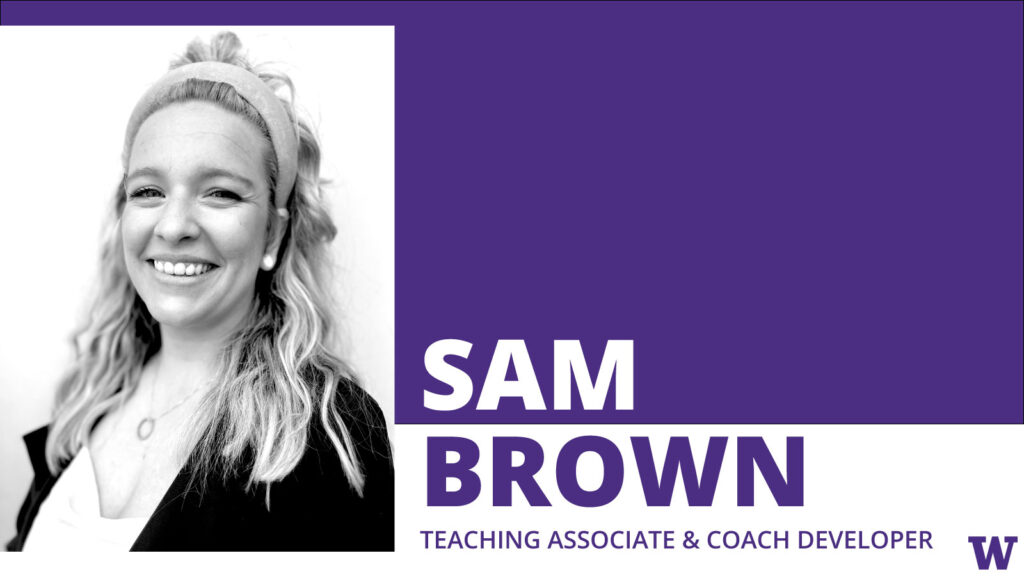
Welcome Sam Brown

We are proud to announce that Sam Brown has joined our team!

Sam has a multifaceted role, encompassing the instruction of undergraduate courses, instruction and mentorship in the Intercollegiate Athletic Leadership M.Ed. graduate program, the development of sport and education curriculum, the management of both current and prospective grants, and active participation in our coach training services. Prior to joining UW, Sam worked as the Director of Appeals and Education Development at the Washington Interscholastic Activities Association (WIAA). She earned her M.Ed. (the Intercollegiate Athletic Leadership) University of Washington and her B.A. (Psychology) from Western Washington University.